I will start this page with the credits!
First Richard found a newspaper article and shared it with me for H & S, and he asked if I might have a picture. Well - no I hadn’t. But I knew a collector Keith, and asked him? He said no but he’d ask Jane, and Jane said no, but leave it with her. Then Jane contacted the Midland Railway archive, and bingo, they shared their archive pictures, which had been cleaned by their volunteer Ian Howard. So Jane has shared it with me for H & S.
All are volunteers with various groups or societies. Wonderful! Kay |
Dave Harris
Co-ordinator @ Midland Railway Study Centre |
Jane Demet
Museum @ Rushden Historical Transport Society |
One of the most alarming Accidents that has ever occurred on the Midland Railway in this district, and one which, but for the presence of mind of a signalman, might have resulted in considerable loss of life, occurred on that line about a mile and a half from Wellingborough Station, late on Saturday night. The scene of the occurrence was at what is known as the Irchester Junction Signal-box, which stands at the entrance to the Rushden and Higham Ferrers branch line, and which controls the traffic as it enters upon or arrives from that line. The trains upon this railway on the outward journey from Wellingborough run along the up goods or slow line, till the viaduct over the Nene valley is passed, when they slow down and are turned on the the single line, which here branches off to Rushden by the signal-box just mentioned, from which the points are worked, and where the driver of the out-going train has to pick up a “tablet”. On the return journey the trains are received from the Rushden line and crossed over to the down main goods line, the driver in passing the box having to hand back the “tablet” to the signalman. Of course when a train is approaching from Rushden the signals are set against any train coming on the down goods line, and should there be one about, it is the duty of the driver of such train to pull up and wait until the Rushden train is out of the road. In order to provide against possible contingencies, “catch points’ are also placed some distance from the junction, so that any engine coming past its proper limit when the line in front is about to take on a Rushden train it should be thrown off and stopped. It is, however, the obvious duty of a driver to se that he does not get so far, but to pull up clear of the “catch points”.
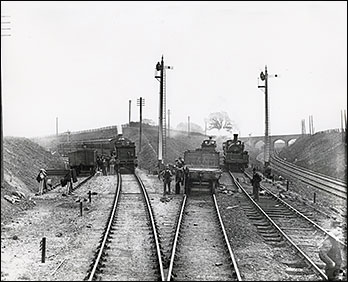
| 'Irchester Junction following the accident of 1st September 1894.
On the left is a passenger train hauled by a tender engine running tender first on the Higham Ferrers branch. The train became trapped as a result of the derailment of a Down goods train blocking the junction. On the goods lines some work is taking place to repair damage to the permanent way and there is a gang of men with locomotives on the Up and Down goods lines plus various wagons, some of which appear to belong to the Engineer's Department. There is also an excellent view of a trap point and two signals. In the background is a multi-arch masonry overbridge.'
This photograph is a copy of Derby negative DY 606.
|
|
|
|
|
The aftermath of the accident here on 1.9.1894. An easterly view from the intersection of the branch line and the Down goods line towards the waiting branch line train. Five men on the ground alongside the branch 0-6-0 were looking on as were the enginemen from their cab. Workmen had arrived on a breakdown train and were also looking on. DY606. The original print had been disfigured by many mould marks on the negative. This version has been cleaned by Ian Howard.
|
It was just one of these contingencies which arose on Saturday night, and which caused such devastation. On Saturday nights only, a late passenger train leaves Higham Ferrers for Wellingborough at ten minutes to eleven. It is due to reach the Irchester Junction box just about eleven, and its destination five minutes later. On this occasion everything had worked smoothly all through the day, and the signalman (John Harrison, a young man lodging at Rushden) made due preparations to receive the late train by setting the points, showing line clear for the Rushden driver, and by keeping the signals up against any such train coming on the down goods road, one such train being due about this time. The last-named was seen to be approaching, but, as it is stated, the lights were against it, the signalman thought it was sure to pull up as usual. To his astonishment and terror, as he realised what might happen if the trains came into collision at the junction, the signalman saw the goods train approaching a rapid rate, and waving his red light from the window of the box endeavoured to stop it. But it was then too late, the train with its heavy load of 27 wagons came thundering on - it was an express goods - the engine jumped off at the “catch points” and then jumped on again, but the tender and the whole of the trucks left the line, and being dragged on by the engine, tore up the permanent way for a distance of a hundred feet or more. Then, with the sudden impact of the driver pulling up sharply, the trucks were hurled in all directions, some being piled upon each other; whilst the contents of those that were loaded scattered in all directions. One of the trucks, a big heavy vehicle, dashed right across the up road into the signal-box, which it shifted bodily some 18 inches or more, smashing the lower part of the box to atoms, knocking down the step-ladder, and doing very much mischief. All this time Harrison was in his box, and the escape he had from instant death or terrible injury was almost miraculous, but the upper part of the box in which he was, was fortunately not so badly wrecked. As it was, however, he got a terrible shaking, and the shock to his nerves was enough to prostrate any man. But, with commendable presence of mind, he at once set himself to work to stop the Rushden train, which in another second or two must, unless stopped, come dashing into the debris, with almost inevitable loss of life to the passengers within it. All attempts to set the signals against it were useless, owing to the wrecking of the apparatus, and Harrison could not leave his box by the ordinary way through the step-ladder being carried off.
|
|
|
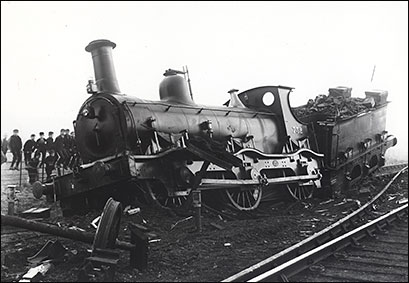
The aftermath of the accident here on 1.9.1894.
A front ¾ view of Johnson-rebuilt Kirtley 700 class 0-6-0 No. 752 on its side by the trackside damaged and de-railed after the accident. Several boys look on from the iron boundary fence. DY604.'
|
Without a moment’s hesitation, he seized his lamp, jumped from the window to the ground, and ran along the Rushden line, ascended the ladder of a signal post, and from that exalted position waved his red lamp. The guard of the wrecked goods train also ran along the line to warn the on-coming train, which fortunately was a light one and fitted with automatic brakes, so that as soon as the driver saw the warning lights waving in front of him, he was able to pull up within a hundred yards or so of the wreckage. Had the accident been half a minute later, or the signalman been unable to warn the Rushden train, the consequences must have been deplorable, as even if the driver had seen the wreck he could scarcely have escaped it, as both lines were blocked by it and the rails torn up. As it was impossible for this train to proceed, the passengers had to alight, and, guided by Platform foreman Morris (of Wellingborough) and the guard, they were escorted with the aid of the roof lamps from the carriages, along the line to Wellingborough.
Meantime considerable uneasiness was felt at Wellingborough Station by the non-arrival of the train; the man at the box had had notice of it, but nothing more was heard, and when it did not arrive within ten minutes or so of its appointed time, the stationmaster (Mr Turner) with other officials, started up the line to investigate, their fears as to an accident being confirmed by the information that the noise of a “smash” had been heard by a man located not far from the station. On the way, they met the passengers on their unaccustomed and unexpected walk, and obtained from them some idea of what had occurred. As promptly as possible the breakdown gangs at Wellingborough and Bedford were sent for, and the leading local officials of all departments advised of the occurrence, and within a very short time the scene was invaded by upwards of a hundred men, down from Wellingborough and Bedford, with steam and hand cranes, and all the requisites for clearing the line and repairing the damage that had been done. The telegraph had been kept busy, and messengers sent hither and thither calling up the men to accomplish this rapid gathering of “strength”, and too much praise cannot be given to all for the promptitude displayed.
It was now seen how extensive was the damage that had been done: the permanent way was torn up for quite a hundred feet, rails were twisted in all shapes, the “chairs” were smashed and signal wires were lying twisted and tangled in all directions; whilst amidst all was the wreckage of the trucks, strewn about the ground along the whole extent of the train, some of the vehicles being overturned and lying in all conceivable positions. One of them had rolled down the bank on to the fast line, and a part of it had to be sawn away before that line was clear. There was not one of the twenty-six trucks but left the line, and most of them were damaged, whilst some were smashed completely to atoms, the wheels only remain ing intact. Great heavy chests of tea, which some of the trucks contained, were thrown out and smashed, and their contents more or less scattered; other packages, containing fruit etc., were also lying about the ground and the scene altogether was of indescribable havoc and confusion. When the signal-box came to be examined, it was apparent all the more what a narrow escape its occupants had had, for so great had been the force with which it was struck that the name plate and ledge along by the windows were found to be torn away, and the signal apparatus all put out of use. By the aid of light from the fires, made with wood from the débris of the broken vehicles, the breakdown gangs worked all through the night; and skilled artisans engaged in other ways in repairing the damage done, under the Superintendance of the various officials, amongst whom were: Inspector Baily (Superintendent’s Department, Wellingborough), Mr Evans (Goods Department, Leicester), Mr Cook (Permanent Way department, Bedford), Mr Leech (Telegraphs, Bedford), Mr Elks (signalling, Kettering), Mr Margerisson (Locomotive Department, Wellingborough), Mr Slocum (Locomotive Department, Bedford), Mr Turner (Stationmaster, Wellingborough), Mr Harrison (Irchester Station) etc., but it was Sunday dinner-time before the wrecked wagons were got clear, so that the permanent way men could get uninterruptedly on their work.
Large crowds of people from Rushden, Irchester and Wellingborough lined the banks on both sides of the railway from an early hour on Sunday morning and watched the operations in progress throughout the day, the marvellous lifting power of the enormous steam crane, one of only four which the Midland Railway have at work, and which has recently been placed at Wellingborough, being regarded with much interest. It was a very busy sight all the day, the little army of men being apparently inextricably mixed up in their work, but all were engaged in their separate departments, each under the control of an experienced official, so that their labours were regulated like clockwork and the result was soon to be seen in the in the clearance made and the repairs effected. During the time the lines were blocked the goods trains as well as the passengers were run on the fast lines, but as very few trains were running on Saturday nights or Sundays there was little interruption in the ordinary traffic, and today things have resumed their usual conditions, as far as the running of the trains is concerned, though it will be some days before the line is in proper order again.
As to the cause of the accident, it is stated, though the railway officials are naturally reticent upon the point, that is was thought the driver of the goods train, a Sheffield man, mistaking his signal that he took the green light shown for the Rushden train as his own - but whether this was so or not will be made clear at the enquiry, which the Company are sure to make, when it may be depended upon they will endeavour to make such arrangements that a similar occurrence may not take place again. During Sunday morning Mr Scotton, the official photographer to the company, of Derby, was present and took several views of the scene to assist the officials in their enquiry. Competent railway men, who have been interviewed by our representative, state that the driver of the goods train must have been going at a rapid rate, for if he had been going slowly when his engine was thrown off by the “catch points” the train would have been directly brought to a stand, and though the trucks would have been knocked about, there would not have been anything like the amount of damage done. One thing which helped to save the Rushden train is that it was slowing down as it approached the junction for the purpose of giving up the “tablet”. Thus the driver had it well in hand and was able to promptly pull up when he saw the red lamp moving in front of him. On all hands the greatest praise is expressed for the conduct of signalman Harrison, who had been naturally much upset at the occurrence. The passengers in the train from Rushden were surprised at the train stopping but they knew nothing of what had happened till they were asked to alight, and when they heard what a narrow escape they had had, they were full of thankfulness for the signalman’s presence of mind. There are usually a good number of passengers by this train but on Saturday there were only 15.
On enquiry, we learn that neither the driver, fireman or guard of the wrecked train were injured. The damage is expected to amount to £2000.
|